
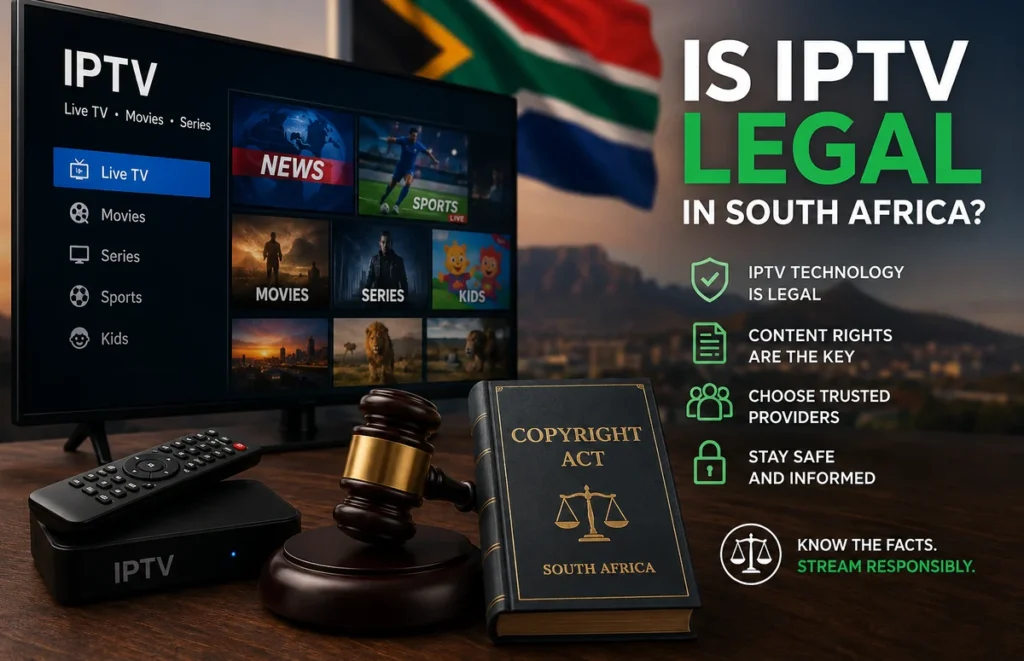
Is IPTV legal in South Africa? The simple answer is that IPTV technology itself can be used legally. IPTV is simply a method of delivering television and video through an internet connection. The important question is whether the service has permission to distribute the channels, films, sports or other content it provides.
A legitimate IPTV service should be transparent about its business, subscription terms, supported devices and the content it is authorised to distribute. Problems arise when a service provides copyrighted television, premium sports or movies without permission from the relevant rights holders.
This guide explains the difference between legal IPTV technology and unauthorised streaming, what South African viewers should check before subscribing and how to avoid services that may create legal, privacy or security risks.
What Is IPTV?
IPTV stands for Internet Protocol Television. Instead of receiving television through a satellite dish, terrestrial aerial or traditional cable connection, an IPTV stream is delivered through the internet.
The technology can be used by legitimate broadcasters, subscription services, telecommunications companies and other authorised content providers. IPTV can also be viewed on many types of devices, including Smart TVs, Android TV devices, phones, tablets and computers.
The technology itself does not determine whether a service is lawful. The source of the content and the provider’s right to distribute it are what matter.
Is IPTV Legal in South Africa?
If you are asking is IPTV legal in South Africa, it is important to separate the technology from the content being delivered.
Using an IPTV-compatible application, Smart TV or media player is not automatically illegal. Problems can arise when copyrighted content is distributed or accessed without the necessary permission from the copyright owner or authorised distributor.
South Africa’s Copyright Act regulates copyright protection for works including films, broadcasts and other protected material. Viewers should therefore avoid assuming that a service is legal simply because it can be installed on a television or purchased online.
You can read the South African Copyright Act on the official government website for the underlying legislation.
Legal IPTV vs Unauthorised IPTV
| Area | More trustworthy sign | Possible warning sign |
|---|---|---|
| Content rights | Provider explains what it is authorised to offer | Claims every premium service is included without explanation |
| Business details | Clear contact details and service information | Anonymous website with no identifiable support |
| Pricing | Prices, durations and renewal conditions are clear | Hidden fees or pressure to pay immediately |
| Applications | Uses recognised players or verified downloads | Requires unknown APK files or disabling security |
| Support | Clear installation and customer-support process | No support after payment |
| Claims | Realistic description of the service | Promises every premium channel, sport and movie worldwide |
Copyright Is the Key Issue
When people ask is IPTV legal in South Africa, copyright is one of the main issues to understand.
Television programmes, films, sports broadcasts and other video content can be protected by copyright. A company normally needs the necessary rights or permission before commercially distributing protected content.
A viewer cannot reliably determine legality only from the number of channels shown in an application. A playlist containing thousands of channels does not prove that the provider has obtained the required rights.
This is why choosing a transparent provider is more important than choosing the service with the largest advertised content library.
Does Using an IPTV Player Make IPTV Illegal?
No. A media player is simply software used to organise and play compatible video sources.
Applications that support M3U playlists, portal logins or other formats can have legitimate uses. Installing a player does not automatically give the user television channels, movies or sports rights.
The same player could be used with authorised streams, personal media or content distributed without permission. The legality therefore depends primarily on the source and rights associated with the content.
For installation information, see our IPTV setup guide.
What About Free IPTV Playlists?
Free playlists require additional caution. Some contain legitimate free-to-air, public or openly distributed streams, while others may copy protected streams without the owner’s permission.
Do not assume that a playlist is authorised simply because it is available through a search engine, social network, forum or public repository.
Avoid downloading files from unknown websites or entering personal account details into suspicious players. Our free IPTV playlist safety guide explains what to check before opening a playlist.
How Can You Identify a Suspicious IPTV Service?
If you are researching is IPTV legal in South Africa before buying a subscription, check the provider carefully.
Warning signs can include:
- Claims that every premium television network is included.
- Access to large numbers of paid sports services without any explanation of rights.
- No terms of service or refund information.
- No clear customer-support contact.
- Requests to disable antivirus or device security.
- Unknown applications downloaded from unrelated websites.
- Prices that appear unrealistic compared with authorised services.
- Requests for cryptocurrency or unusual payment methods without normal business information.
- Shared usernames or passwords published publicly.
No single sign automatically proves that a service is unlawful, but several of these signs together should make you investigate further before paying.
Does ICASA Regulate Television Services?
South Africa’s Independent Communications Authority, ICASA, has responsibilities relating to broadcasting and electronic communications licensing and compliance.
However, internet-delivered video services can involve different regulatory questions depending on how the service operates. Consumers should therefore avoid assuming that every website calling itself an IPTV service has automatically received regulatory approval.
The safest approach is to check the provider, its business information and its authority to distribute the content it sells.
Can You Get in Trouble for Watching Illegal Streams?
This is where simple yes-or-no answers become misleading. The exact legal consequences can depend on what happened, how the content was accessed, whether it was redistributed and other circumstances.
South African authorities have publicly supported stronger action against content piracy. For that reason, viewers should avoid intentionally using services that clearly distribute copyrighted material without permission.
This article provides general consumer information and should not be treated as individual legal advice.
How to Choose IPTV More Carefully
Instead of focusing only on whether a provider offers a huge channel list, compare practical and legal indicators.
- Check who operates the service.
- Read its terms and privacy information.
- Ask what devices are supported.
- Check the number of permitted simultaneous connections.
- Ask whether a trial is available.
- Review cancellation and refund conditions.
- Look for realistic content descriptions.
- Avoid services that make unclear claims about premium content.
A short trial is also useful for evaluating technical quality before choosing a longer plan. Read our IPTV free trial guide to see what you should test.
Is Cheap IPTV Automatically Illegal?
No. Price alone does not determine whether a service is lawful.
A cheaper service may simply offer fewer features, a shorter subscription or a smaller content package. At the same time, an unusually low price combined with claims of unrestricted access to large amounts of premium content can be a reason to investigate further.
Focus on transparency, content rights, business information and service terms instead of using price as the only indicator.
Is IPTV Smarters Pro Legal?
An IPTV player and an IPTV provider are not the same thing. A player can be used to display content supplied by different sources.
The legality of what you watch depends on the source of the content and whether the necessary rights exist, rather than simply on the name of the media player installed on your device.
Frequently Asked Questions
Is IPTV legal in South Africa?
IPTV technology can be used legally in South Africa. The important issue is whether the television, movies, sports and other copyrighted content being distributed are provided with the necessary permission or rights.
Are all IPTV providers legal?
No. Providers differ significantly. Some may distribute authorised content, while others may offer streams without clear permission. Check the provider rather than assuming that all IPTV services operate in the same way.
Is an M3U playlist illegal?
An M3U file is simply a playlist format. Its legality depends on the streams contained in the playlist and whether they are authorised for distribution and viewing.
Can I legally use an IPTV player?
A compatible media player has many legitimate uses. Installing the player itself does not determine whether the content played through it is authorised.
How do I know whether an IPTV provider is trustworthy?
Look for clear business information, transparent pricing, written terms, realistic claims, customer support and information about the service being provided. Be cautious when the source of premium content is unclear.
Final Thoughts
So, is IPTV legal in South Africa? IPTV is a technology for delivering video over the internet and can be used for legitimate services. The legal concern is primarily whether protected content is being distributed and accessed with the appropriate rights and permissions.
Before subscribing, investigate the provider, read its terms, protect your login information and avoid offers that appear to provide unauthorised premium content.
You can also explore our guide to comparing IPTV suppliers or review the available IPTV plans in South Africa after checking that a service meets your requirements.
Ready to Choose Your Streaming Plan?
Once you understand the legal considerations and your device setup is ready,
view our IPTV plans →
and compare the available options before making your choice.